
Vector Illustration Posters
Vector illustration arose in the late twentieth century with the advent of digital computing, as mathematical definitions enabled images to remain crisp at any scale; landmark tools like Adobe Illustrator (1987) made this approach widely accessible to artists and designers. Its philosophy asserts that visual clarity and precision—achieved through smooth, mathematically constructed forms—constitute a distinct digital beauty anchored in deliberate geometry and infinite scalability.
5 credits for new user registration. No credit card required.
Create Your Own Vector Illustration Poster
Use our AI generator to design Vector Illustration posters in seconds with full commercial rights.
Create Vector Illustration Poster

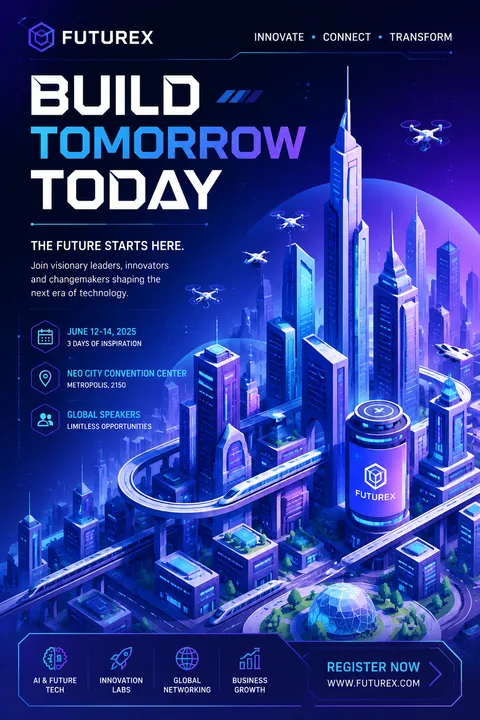



Turn Ideas into Art in Seconds
Describe Your Vision
Simply type your idea or concept for the poster.
Select Vector Illustration Style
Our AI applies the specific Vector Illustration design rules to your concept.
Customize & Download
Fine-tune colors, add text, and export in high-resolution.
Why Designers Choose Us
The professional choice for AI-generated design
Instant Speed
Results in < 30s
CC0 License
100% Commercial Use
Fully Editable
Layer-by-layer control
High Res
Print-ready quality
About Vector Illustration Design
History of Vector Illustration
Design Philosophy
Related Keywords
Vector Illustration FAQ
Quick answers about designing Vector Illustration posters.
What makes vector illustration different from other digital art forms?
Vector illustration uses mathematical equations and geometric primitives—points, lines, curves, and shapes—to create images, rather than pixel-based raster graphics. This fundamental difference means vector artwork can be scaled to any size without losing quality or becoming pixelated. Artists manipulate Bezier curves and anchor points to create smooth, clean lines with precise control. This resolution independence makes vector art ideal for logos, icons, and any design that needs to work across multiple sizes.
What are the common styles within vector illustration?
Vector illustration encompasses several distinct styles. Flat design uses simple lines and solid colors for clean, minimalist graphics perfect for icons and interfaces. Line art employs straight or curved lines against plain backgrounds for elegant simplicity. Geometric art builds compositions from basic shapes for abstract, modern effects. Cartoon style features bold outlines and bright colors for character design and animation. Many contemporary artists also blend 2D vector work with 3D elements or traditional media for hybrid approaches.
What software is used for creating vector illustrations?
Professional vector illustration typically uses specialized software like Adobe Illustrator, CorelDRAW, or the free open-source option Inkscape. These programs provide tools for creating and manipulating paths, shapes, gradients, and typography. They support features like layers, artboards, and export to various formats including SVG, EPS, and PDF. Many designers also use Figma or Affinity Designer for vector work, especially when combining illustration with interface design.
What are current trends in vector illustration design?
Contemporary vector illustration shows a growing preference for organic, hand-drawn aesthetics as a counterpoint to AI-generated content. Artists increasingly blend 2D vector work with 3D rendering, or combine digital techniques with traditional media textures. Vivid gradients and bold color choices remain popular, while there's also renewed interest in textured, imperfect lines that bring warmth to the typically clean vector aesthetic. Isometric illustrations and character-driven brand identities continue to be widely requested.
Ready to design your next poster?
Create Vector Illustration Poster