
hand-sprayed tag Posters
Street art took shape in the late 1960s and 1970s on the streets of Philadelphia and New York, where figures like Cornbread and TAKI 183 pioneered unsanctioned public mark-making that rapidly evolved into a global movement. Its philosophy centers on creative occupation of public space—visibility itself becomes a message, and legitimacy derives from presence rather than permission. Street art’s visual language asserts agency through bold, immediate gestures that challenge boundaries between artist, audience, and the urban environment.
5 credits for new user registration. No credit card required.
Create Your Own hand-sprayed tag Poster
Use our AI generator to design hand-sprayed tag posters in seconds with full commercial rights.
Create hand-sprayed tag PosterThe Art of hand-sprayed tag?
Turn Ideas into Art in Seconds
Describe Your Vision
Simply type your idea or concept for the poster.
Select hand-sprayed tag Style
Our AI applies the specific hand-sprayed tag design rules to your concept.
Customize & Download
Fine-tune colors, add text, and export in high-resolution.
Why Designers Choose Us
The professional choice for AI-generated design
Instant Speed
Results in < 30s
CC0 License
100% Commercial Use
Fully Editable
Layer-by-layer control
High Res
Print-ready quality
About hand-sprayed tag Design
History of Street Art
Design Philosophy
Related Keywords
hand-sprayed tag FAQ
Quick answers about designing hand-sprayed tag posters.
How does street art differ from graffiti?
Graffiti is primarily word-based, created by self-taught 'writers' for personal branding through stylized tags and lettering within their community. Street art typically comes from formally trained artists who create image-based works with messages for the general public. While graffiti is often unauthorized, street art is frequently commissioned or permitted, and tends to focus on broader social themes rather than individual identity.
What techniques and forms define street art?
Street art encompasses large-scale murals covering entire building walls, stencil work for precise repeated images, wheat-paste posters, and three-dimensional installations using materials like metal and found objects. Unlike traditional graffiti's 'wildstyle' lettering, street art often features figurative imagery, portraits, and symbolic content designed to engage passersby with visual narratives or social commentary.
What are the visual characteristics of graffiti style?
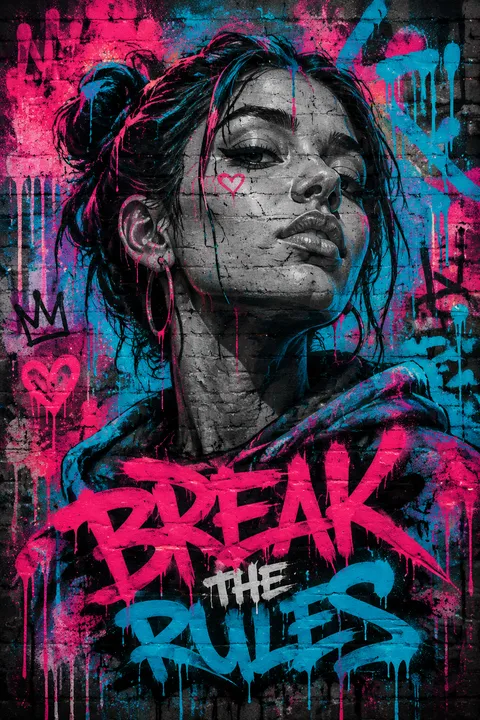
Graffiti features bold, vibrant colors with highly stylized, abstract lettering ranging from simple tags to complex 'wildstyle' compositions. Techniques create intricate patterns, textures, and three-dimensional effects. Cartoon-like characters often accompany letter-based work. The aesthetic embraces a rebellious energy with spray paint textures, drip effects, and layered compositions that command attention in urban environments.
How has street art influenced urban culture?
Street art has transformed urban landscapes worldwide, turning blank walls into vibrant canvases that reflect community identities and stories. What began as an underground movement has entered galleries, museums, and private collections as 'urban art.' Cities now commission murals to revitalize neighborhoods, and artists like Banksy have achieved mainstream recognition while maintaining street art's tradition of challenging established norms.
Ready to design your next poster?
Create hand-sprayed tag Poster